

The Workplace Friction Index: A New Way to Measure Your Office Experience


Workplace teams have always been able to feel friction. What they haven't had is a way to measure it.
A meeting moves to virtual because the room fell through. Someone loses ten minutes hunting for a desk that's already taken. A colleague shows up expecting a full floor and finds half the team chose to work remote. On their own, these moments look like nothing.

But here's the thing: they're not isolated. A study of 514 workplace professionals found that 60% of Workplace Operations professionals say friction has gotten worse over the past year. Only 12% say it's improved. That's a net gap of +48 points!
If you're looking for a way to measure your office experience, the Workplace Friction Index is a good place to start. Here's what it is and how it works.
Why Workplace Friction Has Resisted Measurement
Part of the reason friction has stayed invisible for so long is that many organizations run their workplace on a stack of point solutions: room booking in one tool, desk reservations in another, visitor management in a third, services in a fourth. Each tool sees its own slice of the problem but none of them sees the whole.
That fragmentation trains everyone to treat friction as a string of unrelated tickets instead of one coherent pattern.
Introducing the Workplace Friction Index
The Workplace Friction Index is a 0-to-100 score built from 20 questions across five dimensions of workplace experience. It comes out of original research with 514 workplace professionals, 205 in Workplace Operations and 309 end users, conducted in partnership with The Collab Collective.
The Five Dimensions It Measures
The five dimensions include:
- Room Availability — can people find a meeting room when they need one
- AV & Technology — does the gear in the room actually work
- Desk Availability — can people find a place to sit
- Coordination — do people know who's in the office, and when
- Policy — is it clear what employees can do, and where
Where the Score Puts You
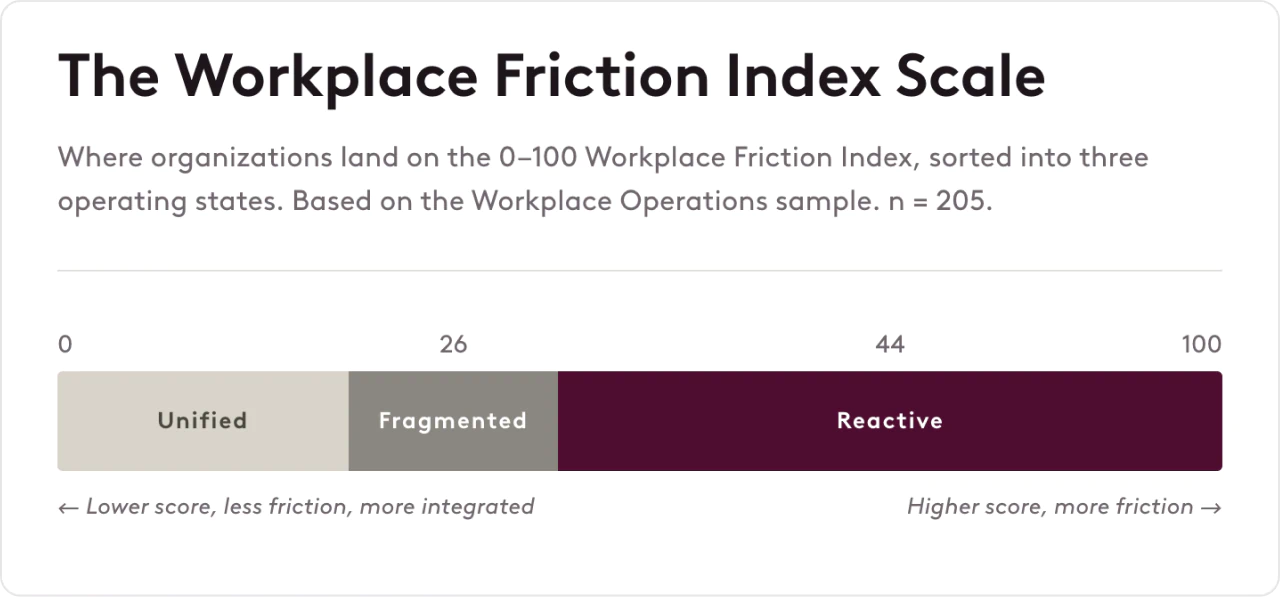
The mean Workplace Friction Index score among Workplace Operations respondents is 36.8. A lower score means less friction. Most organizations fall between 26 and 44. The best-performing 10% score below 18. The most challenged 10% score above 61.
Curious where your own organization lands before reading further? Take the interactive Workplace Friction Index quiz and get your score in a few minutes.
The score sorts into three operating states, running from Unified at the low end for friction, through Fragmented, to Reactive at the high end.
Where your team falls has a significant impact on your office. In the most Reactive organizations, 63% of end users say workplace friction is a noticeable drag on their productivity. In the most Unified organizations, only 14% say the same. That's 4.5 times the rate of felt friction, for the same kind of job, in the same kind of office!
"The biggest frustration is how much time gets wasted trying to coordinate space."
— Workplace Operations professional, technology, mid-market
How to Use Your Score
Once you place yourself on the tier scale, and know what territory you're actually working from, here are some follow up steps on what to do next:
- Use your tier to calibrate the real cost of your coordination tax. Our guide to building a business case walks through translating your score into a dollar figure leadership will act on.
- Use the dimension-by-dimension breakdown to prioritize where you look first. This workplace systems audit guide shows you how to trace a high score back to its root cause instead of patching the loudest symptom.
Get Your Score
The Workplace Friction Index gives workplace leaders something they've never had: a shared, validated language for a problem most have been managing on instinct alone.
Take the interactive Workplace Friction Index quiz to see where your organization lands, Unified, Fragmented, or Reactive, and what that means for the people working in your building today.